Water Heater Installation in Brownsburg, IN
Water heater installation in Brownsburg, IN covers planned installs in new builds, remodels, fuel conversions and upgrades. It is the scheduled counterpart to an emergency swap, so you can pick the unit, location and time.
Call to talk through the options, and expect a clear price before any work starts.
Planning an install, not rushing one
When a heater fails, you take what you can get. When you plan, you choose. That means sizing the unit to your household, picking a location with proper venting and drainage, and deciding whether this is the time to move to a different fuel or technology.
Brownsburg has added thousands of homes since 2000, with the Town's population going from 14,520 to 28,973 by 2020. That means many water heaters installed during the building boom are now reaching the age where planned replacement beats waiting for a leak.
Decisions to make before the install
These choices change the price and the result.
- ✓Fuel: gas, electric or heat pump. Existing gas lines and panel capacity often settle this.
- ✓Capacity: match first-hour rating to the number of people and bathrooms.
- ✓Location: access for service, floor drain nearby, and clearance for venting.
- ✓Efficiency: higher efficiency costs more up front and saves on the monthly bill.
- ✓Extras: expansion tank, drain pan with a drain line, recirculation loop.
Sizing guide for tank water heaters
These ranges are common starting points, and a plumber refines them on site.
| Household | Typical tank size | Notes |
|---|---|---|
| 1 to 2 people | 30 to 40 gallons | Shorter showers, a single bath |
| 3 to 4 people | 40 to 50 gallons | The most common family size |
| 5 or more people | 50 to 75 gallons | Large tubs and multiple baths |
| Very high demand | Consider tankless | Continuous supply instead of a stored volume |
Planning a water heater install?
Call to book a visit and talk through sizing and fuel.
What a code-compliant install includes
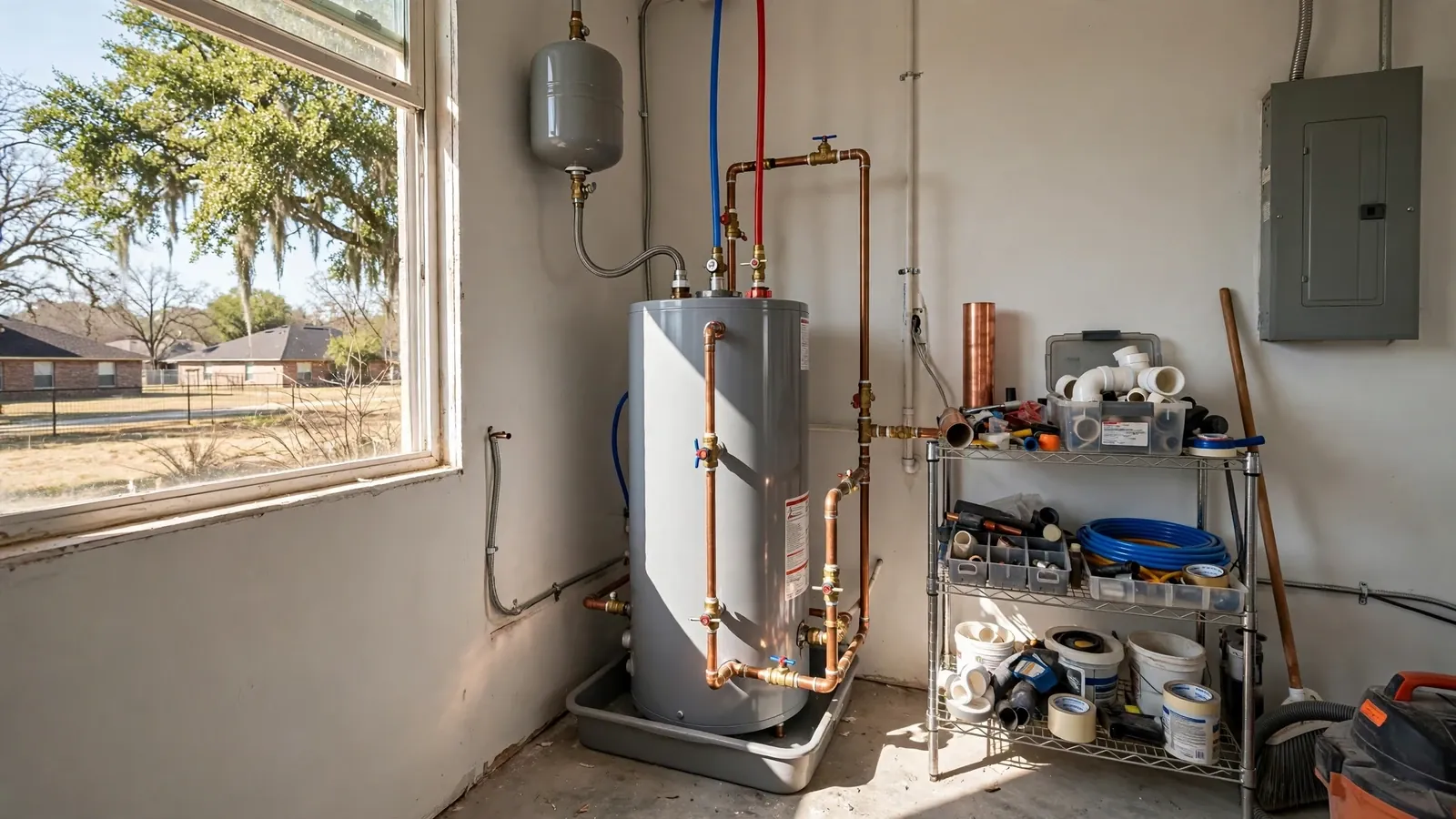
A good install is mostly invisible parts. The relief valve and its discharge pipe, the shutoff valves, the flexible connectors, the venting if gas, the drain pan in places where a leak would cause damage, and the expansion tank where the system is closed.
These parts are the difference between a heater that runs quietly for a decade and one that creates a problem in year four. The Town of Brownsburg requires a permit for plumbing changes, so ask how your project is handled and who requests the inspection.
Tying into Brownsburg water and gas
Brownsburg Water Utilities supplies the water, and the Town owns the meter and meter pit. The property owner is responsible for the line from the meter into the house, so any new shutoff or pressure device sits on your side.
If you are converting from electric to gas, the gas supplier and a licensed gas-fitting plumber have to confirm there is capacity for the added load. Ask before ordering equipment.
What affects the price of installation
The quote reflects the equipment and the site.
Utility and manufacturer rebates exist for some efficient units. Ask your electric or gas supplier what applies, since offers change.
Installation standards in brief
A planned install follows the manufacturer's instructions and the Indiana Plumbing Code, which covers relief valves, discharge piping and expansion control. The Town of Brownsburg requires a permit for plumbing changes, so the inspection checks those items.
Water heater installation questions
A like-for-like tank install often takes half a day. Fuel changes, relocations and tankless conversions take longer.
Often yes, with supply, drain, venting or wiring changes. The cost depends on the distance and the walls and floors involved.
The Town says plumbing changes need a permit. Your plumber can walk through what applies to your job.
Tank warranties vary by model, commonly several years on the tank and a shorter term on parts. Ask for the exact terms in writing.
See water heater replacement for emergency swaps.