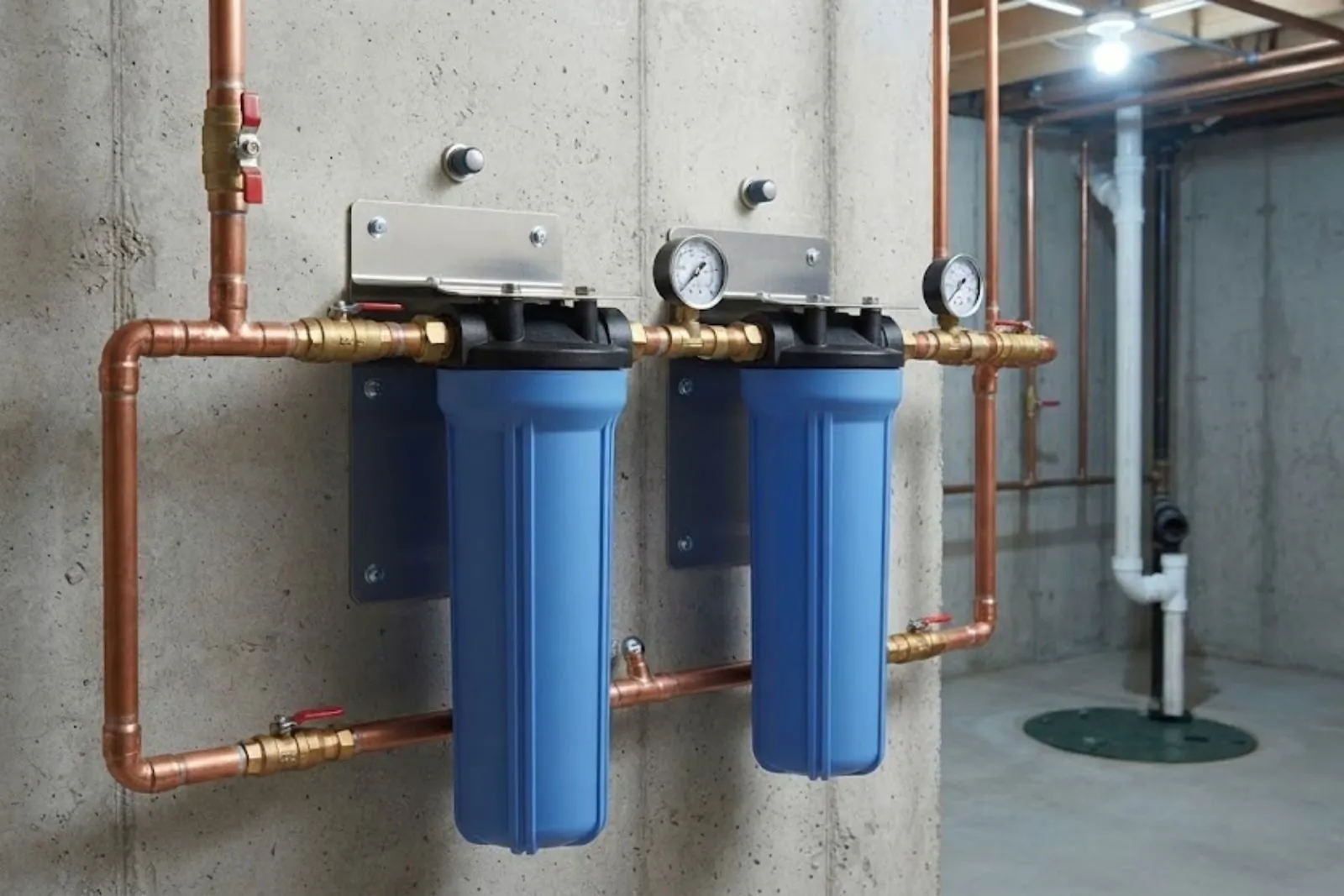
Cold Water Filtration for Brownsburg Homes: Whole-House or Under-Sink
A cold water filter removes particles, chlorine taste or specific contaminants, depending on the type. A whole-house filter treats every tap and protects pipes and appliances. An under-sink filter treats drinking water at one tap. Neither softens water, and the right choice depends on what is in your water and why you want a filter.
This guide explains the types, what they remove and how to choose.
Start with the problem, not the product
People install filters to fix a taste, an odor, cloudy water, stains or a worry about a contaminant. Each of these has a different answer. Chlorine taste and odor respond to carbon. Grit and cloudiness respond to a sediment filter. Hardness needs a softener. A specific contaminant needs a filter certified for it.
Find out what you are treating before you buy. A water quality report from your supplier, and a lab test for private wells, give the facts.
Filter types and what they do
Check the certification on any filter you buy.
| Type | Removes | Does not remove |
|---|---|---|
| Sediment filter | Sand, rust, silt | Taste, dissolved minerals |
| Carbon block | Chlorine, many tastes and odors, some chemicals | Hardness, many dissolved minerals |
| Reverse osmosis (under sink) | Many dissolved solids and some contaminants | Not for the whole house, slow to fill |
| Whole-house carbon | Chlorine taste at every tap | Hardness, unless paired with a softener |
| Water softener | Hardness minerals | Chlorine, bacteria |
Where filters are installed
Location matters for what you get.
- ✓At the main line after the shutoff, for whole-house systems.
- ✓Under the kitchen sink, with a separate faucet, for drinking water.
- ✓On the refrigerator line for ice and water.
- ✓On the shower head for chlorine reduction.
- ✓On a pitcher, which is lowest cost and lowest flow.
Want better tasting water?
Call and we will talk through your options.
Whole-house or point-of-use
A whole-house system protects pipes, water heaters and fixtures from sediment and can improve taste at every tap. It costs more and needs a space on the main line. A point-of-use filter treats only the water you drink and cook with, and costs less.
For many homes, a combination makes sense: a sediment filter at the main to protect plumbing, and an under-sink filter for drinking water. Our water softener and filtration page covers installs.
Filter or softener
They solve different problems, and many homes use both.
Filter
- Targets particles, taste and some contaminants
- Needs cartridge changes
- Does not reduce hardness
- Cheaper to start
Softener
- Removes hardness minerals
- Needs salt
- Protects heaters and fixtures from scale
- Does not reduce chlorine
Brownsburg water: what the sources are
Brownsburg Water Utilities supplies drinking water from groundwater pumped from eight wells drawing from the White River Basin, plus about 400,000 gallons per day purchased from Citizens Energy Group. The Town owns the meter and meter pit.
Public water systems publish annual water quality reports, and the Town can direct you to Brownsburg's. Use it to see what is in your water before you choose a filter, and call the Town at (317) 852-1120 with questions about the supply.
NSF/ANSI 42, 53 and 58 are the standards for taste and odor, health-related contaminants and reverse osmosis, and certification is the way to compare filters.
Reading a filter label and a water report
Look for certification marks from independent testing bodies such as NSF International. A label that says a filter reduces chlorine taste and odor is a different claim from one certified to reduce a named contaminant, and the second is the one that matters if you have a health concern.
Pair the label with your water quality report. If the report shows nothing of concern, you are filtering for taste and comfort, and a simple carbon block does the job. If a contaminant is listed, match the filter to it by name, and ask the installer for the certification sheet.
Maintenance is where filters fail
A filter that is never changed stops working, and a clogged one can slow water to a trickle or become a place where bacteria grow. Put the change date on your calendar the day you install it, and write the date on the housing with a marker.
For an under-sink unit, flush a new cartridge for a few minutes before drinking from it to clear loose carbon fines. For a whole-house unit, note the pressure at a tap when the cartridge is new, so you can tell when flow has dropped enough to change it.
What affects the price of a filter system
Equipment and installation vary.
Filters are not covered by insurance. Some appliance warranties require scale or sediment control, so check yours. We serve Avon and the wider Brownsburg area from the same 24/7 line.
Unsure which filter fits?
Call and we will talk through your water and your goals.
Cold water filter questions
Follow the manufacturer. Sediment and carbon cartridges often last three to twelve months, depending on use.
Only filters certified for lead do. Check the certification, and the Town can tell you about the public system.
A clogged filter can. Changing it on time prevents that.
The Town publishes water quality reports. Read them, and filter only for taste or specific concerns.
Yes. It is a small job when the line is accessible.