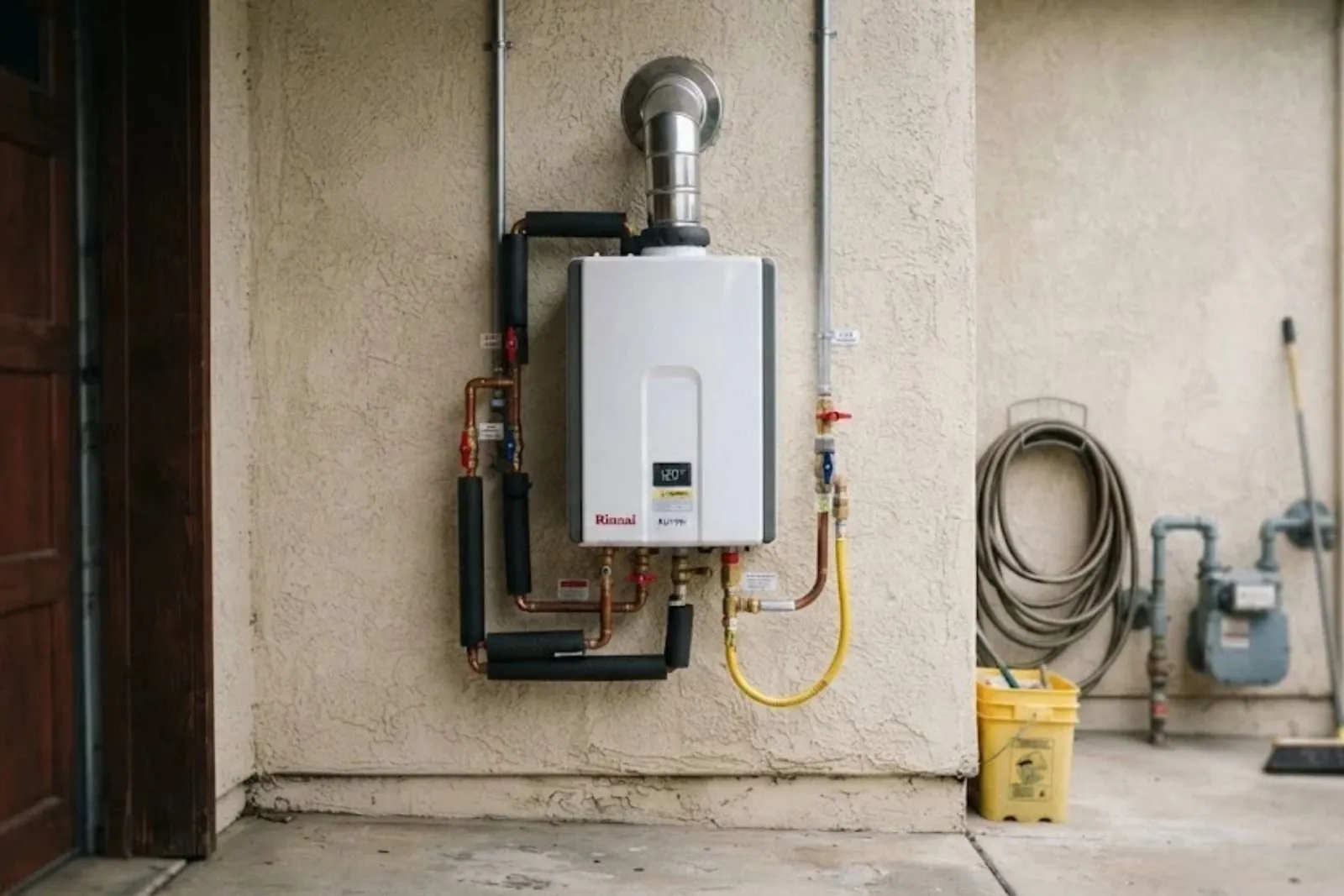
Outdoor Tankless Water Heaters in Brownsburg: Do They Work in Indiana Winters?
An outdoor tankless water heater can work in Brownsburg, but only if it is built for outdoor use and protected against freezing. Indiana cold snaps reach zero, and a unit without freeze protection can crack its heat exchanger. For many homes, an indoor unit is the safer choice.
Here is how outdoor tankless units work, what winter does to them, and when you should think twice.
What an outdoor tankless heater is
An outdoor tankless heater is a unit rated for mounting on an exterior wall. It heats water as it flows, with no tank, and it vents directly to the outside, so it needs no flue through the house.
The appeal is clear. You gain closet space, you avoid running a vent through the house, and in warm climates the install is simple. The trade-off is weather exposure, which is why the climate matters so much.
The freeze problem in central Indiana
Water inside a unit and its supply lines can freeze when temperatures drop. Most outdoor models include built-in freeze protection that uses small heaters, but it depends on electrical power. If the power fails during an ice storm, the protection fails when you need it most.
State winter guidance for homeowners focuses on keeping pipes warm, sealing drafts and letting faucets drip in extreme cold. An exterior wall unit is the opposite of that advice, so the supply and return lines need insulation, heat trace or a drain-down plan.
Outdoor versus indoor tankless in Indiana
A quick comparison for cold-climate homes.
| Factor | Outdoor unit | Indoor unit |
|---|---|---|
| Freeze risk | Higher, needs powered protection | Low in a heated space |
| Venting | Through the cabinet, no flue | Needs a sealed vent through a wall or roof |
| Space | Frees indoor space | Takes wall space inside |
| Service access | Weather matters | Easier in all seasons |
| Winter performance | Very cold incoming water, long runs | More stable |
Thinking about tankless?
Call and we will check your gas line, venting and winter needs.
Questions to answer before choosing an outdoor unit
These decide whether outdoor placement is a good idea.
- ✓Is the unit rated for outdoor use in your climate, and does it have freeze protection?
- ✓Will the supply lines be insulated or heat traced?
- ✓Is power reliable, and is a backup plan in place for outages?
- ✓Does the location allow clearance for service and for snow to shed?
- ✓Is the gas line large enough for the unit's peak demand?
Sizing for cold incoming water
The key number is the temperature rise. A shower at 105 degrees needs the unit to add the difference between the incoming water temperature and 105. In January, incoming water in central Indiana is much colder than in July, so the same unit delivers a lower flow.
Size for winter, not summer. A unit that handles two showers in July may only handle one in January. If your family runs several fixtures at once, ask for a larger unit or a pair.
Winter advice from Indiana regulators
The Indiana Office of Utility Consumer Counselor advises homeowners to insulate exposed pipes, seal drafts and open cabinet doors under sinks during hard freezes. It also advises running a faucet at a pencil-sized stream on an exterior wall when temperatures fall to zero or below.
Those habits apply to any plumbing on an exterior wall, including the lines feeding an outdoor heater. If you choose an outdoor unit, insulate the lines and ask your installer how the freeze protection is powered.
Manufacturers publish outdoor installation standards for clearance, venting and freeze protection, and following them protects the warranty.
Clearances, condensate and service access
Outdoor units need clearance from windows, doors and gas meters, and room on every side for service. Condensing models make acidic condensate that must drain somewhere that will not freeze, and a frozen condensate line can shut the unit down in the middle of a cold night.
Think about snow and ice, too. A unit set below a roof edge can be hit by sliding snow or dripping icicles. Ask your installer where the condensate goes, how the vent is protected and how you reach the unit in January to reset it or clear ice.
What affects the price of a tankless install
Tankless pricing varies more than tank pricing.
Insurance may cover freeze damage that is sudden and accidental, but not neglect. A unit installed without freeze protection can be a problem at claim time. We serve Avon and the wider Brownsburg area from the same 24/7 line.
Outdoor tankless questions
A garage is not outdoors, and an unheated garage can still freeze. An indoor-rated unit in a conditioned space is more reliable.
Use a model with built-in freeze protection, insulate the lines, keep it powered, and consider a drain-down kit for extended cold or absences.
The Town owns the meter and meter pit, and state guidance suggests checking that the pit lid is intact in freezing weather. That is separate from the heater, but the incoming line runs through the same cold ground.
Freeze protection stops. Draining the unit or having a backup power plan is the safeguard.
When you want year-round reliability and easy service. See water heater installation for options.