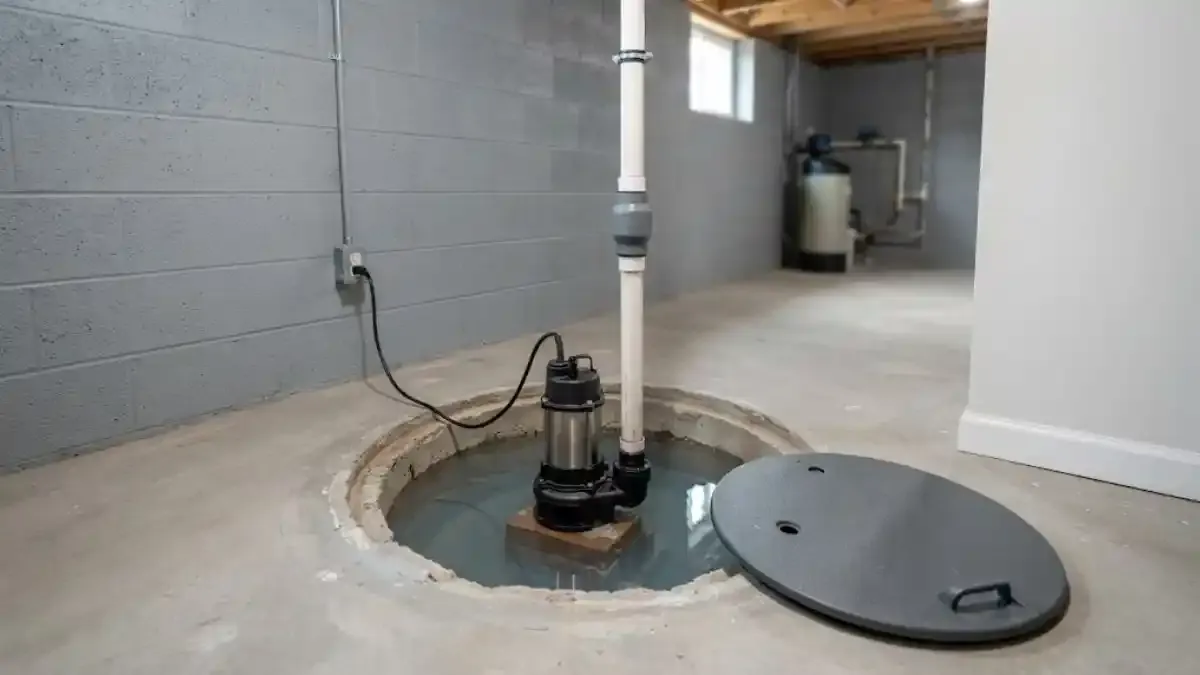
Water-Powered Backup Sump Pumps: Pros and Cons for Brownsburg Basements
A water-powered backup sump pump uses the pressure of your municipal water to push water out of the pit when the main pump fails or the power goes out. It needs no battery and can run as long as the water supply lasts, but it uses a lot of water and does not work on private wells.
This guide explains how it works, where it fits and when a battery system is the better backup.
How a water-powered backup works
The unit is mounted above the sump pit and connected to a cold water supply line. When the water in the pit rises past the primary pump, a float switch opens a valve. Water flows through a device called a venturi, which creates suction and draws pit water into the discharge stream.
The result is that pit water leaves along with the supply water. The unit has no motor and no battery, so power outages do not matter. It works only while the water pressure holds.
Water-powered and battery backup compared
Pick the one that fits your house.
| Factor | Water-powered | Battery backup |
|---|---|---|
| Power source | Municipal water pressure | Battery and charger |
| Run time | As long as water is available | Limited by battery, often hours |
| Water use | High, uses city water to pump | None |
| Pump capacity | Lower, depends on pressure | Often higher |
| Private wells | Not suitable | Works |
| Maintenance | Test valve and float | Replace battery every few years |
What to know before choosing water-powered
These limits decide whether it fits.
- ✓It needs municipal water at good pressure, and it uses a lot of it while running.
- ✓It does not work if your water supply fails, which can happen in a major storm.
- ✓Local rules may limit discharge or require a backflow device on the supply line.
- ✓Capacity falls as water pressure drops.
- ✓Test it every few months so the valve and float do not seize.
Want a backup for your sump pump?
Call and we will go over options.
Backups are about outages and pump failures
A primary pump fails for three common reasons: power loss, a stuck float and a burned motor. A backup that shares none of those weak points is best. Water-powered units avoid the power problem, and battery units avoid the water supply problem.
A high-water alarm that texts or sounds is the cheap insurance on top of any backup. It tells you when the pit is rising before the water hits the floor.
Which backup fits your basement
The home and the risk decide.
Water-powered fits when
- You are on municipal water
- Outages are the main worry
- You want no battery to maintain
- Your pit sees modest inflow
Battery backup fits when
- You want the strongest pumping
- You are on a well
- Water use is a concern
- See sump pump service
Municipal water in Brownsburg and backup pumps
Brownsburg Water Utilities supplies the Town's water from eight wells in the White River Basin plus about 400,000 gallons per day from Citizens Energy Group. Because the Town owns the meter and the property owner owns the line from the meter to the house, a backup tied to the supply line sits on the owner's side.
The Town's water utility asks about backflow protection on devices that connect to the supply. Ask the Town building department at (317) 852-1120 how a water-powered backup is handled, and ask your plumber how the connection is protected.
Indiana Plumbing Code standards and the Town's water rules call for backflow protection on devices connected to the supply line.
Discharge, check valves and the pit itself
Whatever backup you choose, the discharge line decides whether it works. It should run downhill and away from the foundation, and it should not empty where it can freeze or flow back toward the house. A check valve on each pump stops pumped water from falling back into the pit.
The pit should be large enough for two pumps without their floats tangling. A clean, lidded pit keeps debris out of the pumps. If the pit is cracked or filled with silt, fix it first, because a backup in a bad pit is a backup that fails.
What affects the price of a backup system
The unit and the install vary.
Many policies exclude groundwater and pump failure unless an endorsement is added. Ask your agent before storm season. We serve Avon and the wider Brownsburg area from the same 24/7 line.
Testing the whole system
A backup you have never tested is a hope, not a plan. Once a quarter, unplug the primary pump, pour water into the pit until the float rises and watch the backup start, move water and shut off.
Check the discharge outlet outside to see water leaving, and restore the primary pump when you finish. Write the date in your phone so the next test is not forgotten before storm season.
Water-powered sump pump questions
A lot. It may use two gallons of city water for every gallon it removes, so it suits short outages better than days of pumping.
No. A well pump loses power in the same outage, and the system needs steady municipal pressure.
Every few months, by raising the float. Make sure the valve opens and water flows.
It is a backup. A primary pump handles normal inflow at lower cost.
Ask the Town building department and your plumber. A protected connection is typically required.