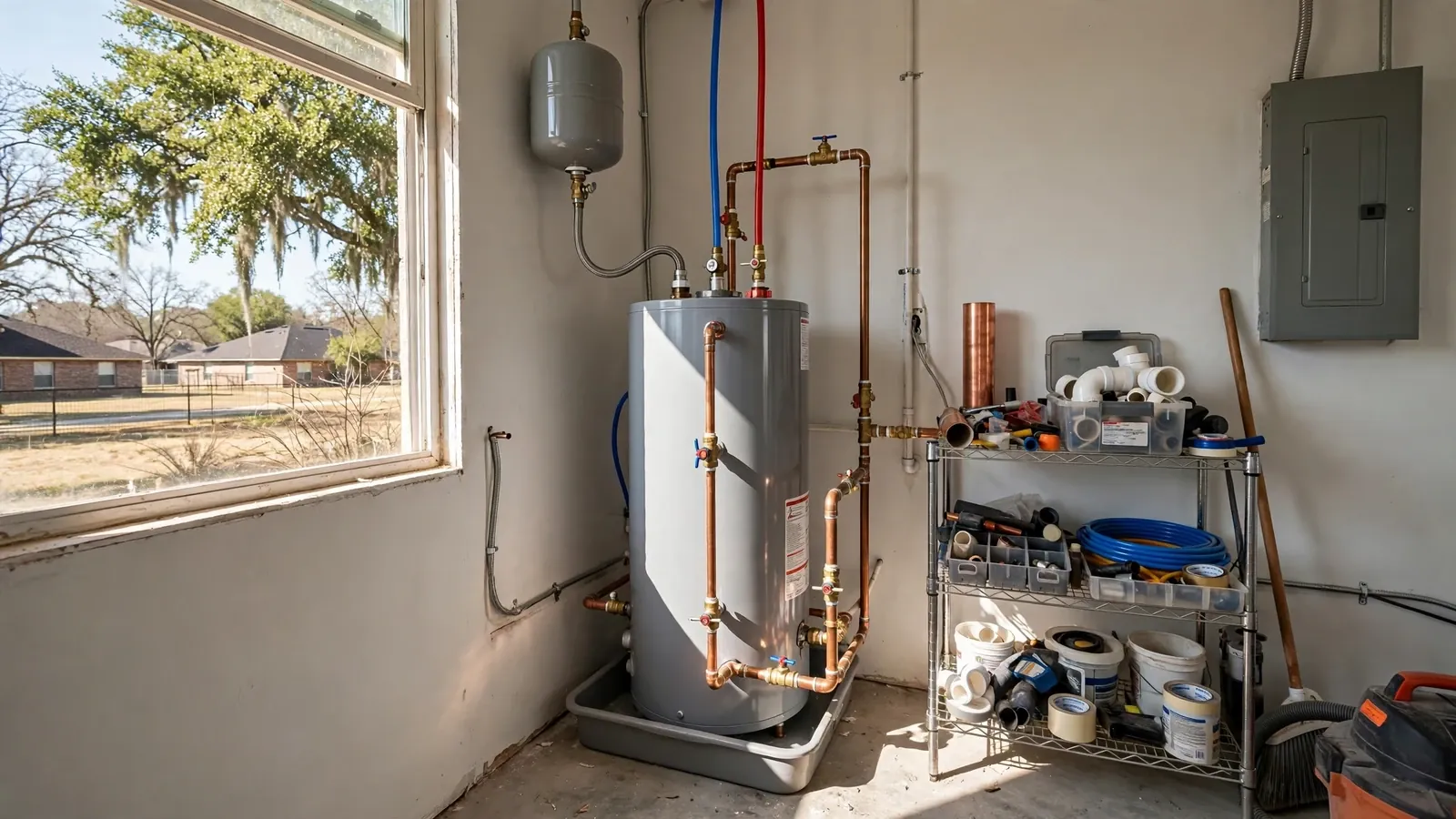
Installing a New Water Heater in Brownsburg: What the Job Involves
A like-for-like water heater swap in a Brownsburg home usually takes two to four hours. The old tank is drained and removed, the new unit is set, connected, vented if it burns gas, and fitted with a new relief valve and discharge pipe. Changing fuel type or moving the unit takes longer.
This guide walks through the steps, the parts that make an install code-compliant, how to size the tank, and what drives the price.
The short version of the install day
On the day, the plumber shuts off the water and the gas or power, then drains the old tank to a floor drain or outside. The tank is disconnected, carried out and replaced with the new unit, set level on a pan if one is needed.
Next come the connections: cold and hot lines with new flexible connectors or copper, the gas line with a fresh flex connector and a sediment trap, or the electrical hookup, and the vent pipe on a gas unit. The tank is filled, air is purged, the unit is lit or powered, and the plumber checks for leaks and proper draft.
Parts that belong on a proper installation
A heater is only as safe as the parts around it.
| Part | What it does | Notes |
|---|---|---|
| Temperature and pressure relief valve | Opens if pressure or temperature gets too high | Needs a full-size discharge pipe ending in a safe spot |
| Expansion tank | Absorbs thermal expansion in a closed system | Common where a check valve or pressure reducing valve is present |
| Shutoff valves | Let you isolate the heater | Replace old stops that will not close |
| Drain pan and drain line | Catch a leak and carry it away | Valuable in finished spaces and over living areas |
| Venting (gas) | Carries combustion gases outside | Must be sized and pitched correctly |
Sizing: how big a tank do you need
Tank size is a balance between household size and how fast the heater recovers. A 40 gallon tank suits most households of two to four people. A family of five or more, or a home with a large soaking tub, often does better with 50 gallons or more.
Bigger is not always better. A larger tank costs more to buy and to keep hot. If you rarely run out of hot water now, match the size of the unit you have. If you run out, size up, or ask about a tankless unit that heats on demand.
Planning a water heater install?
Call to book a visit and a clear price.
Gas or electric: picking the fuel
The fuel you choose follows the house as much as your preference.
Gas water heaters
- Heat water faster, recover quickly
- Need a gas line, venting and combustion air
- Work during power outages if the pilot is standing
- Lower running cost where gas is cheap
Electric water heaters
- No venting, simpler placement
- Need a 240 volt circuit
- Slower recovery on standard units
- Heat pump models save energy at a higher price
Permits when you install a water heater in Brownsburg
The Town of Brownsburg says plumbing repairs and plumbing changes made during remodeling require a permit, and that inspections must be requested at least two business days ahead. The Town building department can be reached at (317) 852-1120.
Ask whoever installs your heater how the permit applies. A permitted install leaves a record that helps at resale and with insurance, and the inspection puts a second set of eyes on the venting and relief valve piping.
Installations follow the Indiana Plumbing Code and the manufacturer's standards, and the U.S. Department of Energy recommends a 120 degree thermostat setting.
Steps a homeowner can take before the plumber arrives
A little preparation saves time and money.
- ✓Clear a three foot path to the heater and the area around it.
- ✓Find the shutoff for the water, the gas valve and the electrical breaker.
- ✓Note the make, size and fuel of the old unit and photograph its rating plate.
- ✓Decide whether you want a recirculation loop, a pan or a new shutoff set.
- ✓Check that the floor drain nearby is open so the tank can empty quickly.
What changes the price of installation
Prices follow the equipment and the site.
Insurance does not usually pay for a planned install. If an old tank has already flooded the house, the water damage may be covered, so photograph it before cleanup. We serve Avon and the wider Brownsburg area from the same 24/7 line.
What to do before and on installation day
A few safety steps protect your home during the swap.
- ✓Keep children and pets away from the work area.
- ✓Make sure the area around a gas heater is clear of storage and flammables.
- ✓Do not run hot water taps during the swap, since the tank will be empty.
- ✓Ask the plumber to test for gas leaks and check the vent after the install.
- ✓Install or test a carbon monoxide alarm for gas units.
Water heater installation questions
Most homes are without hot water for a few hours, and the new tank needs time to heat. A 40 gallon tank can take an hour or more to reach temperature after it fills.
Yes. Plan the swap for a day when you can be without hot water for a few hours, and keep the old one running until the plumber arrives.
The Town requires a permit for plumbing changes. Gas hookups and venting are safety-critical, so a licensed plumber is the right choice for gas units.
Many tank heaters last 8 to 12 years. Flushing the tank each year and checking the anode rod help.
The Town draws groundwater from eight wells, and groundwater carries dissolved minerals. A water test tells you the number, and a softener on the supply, covered on our softener page, slows scale.