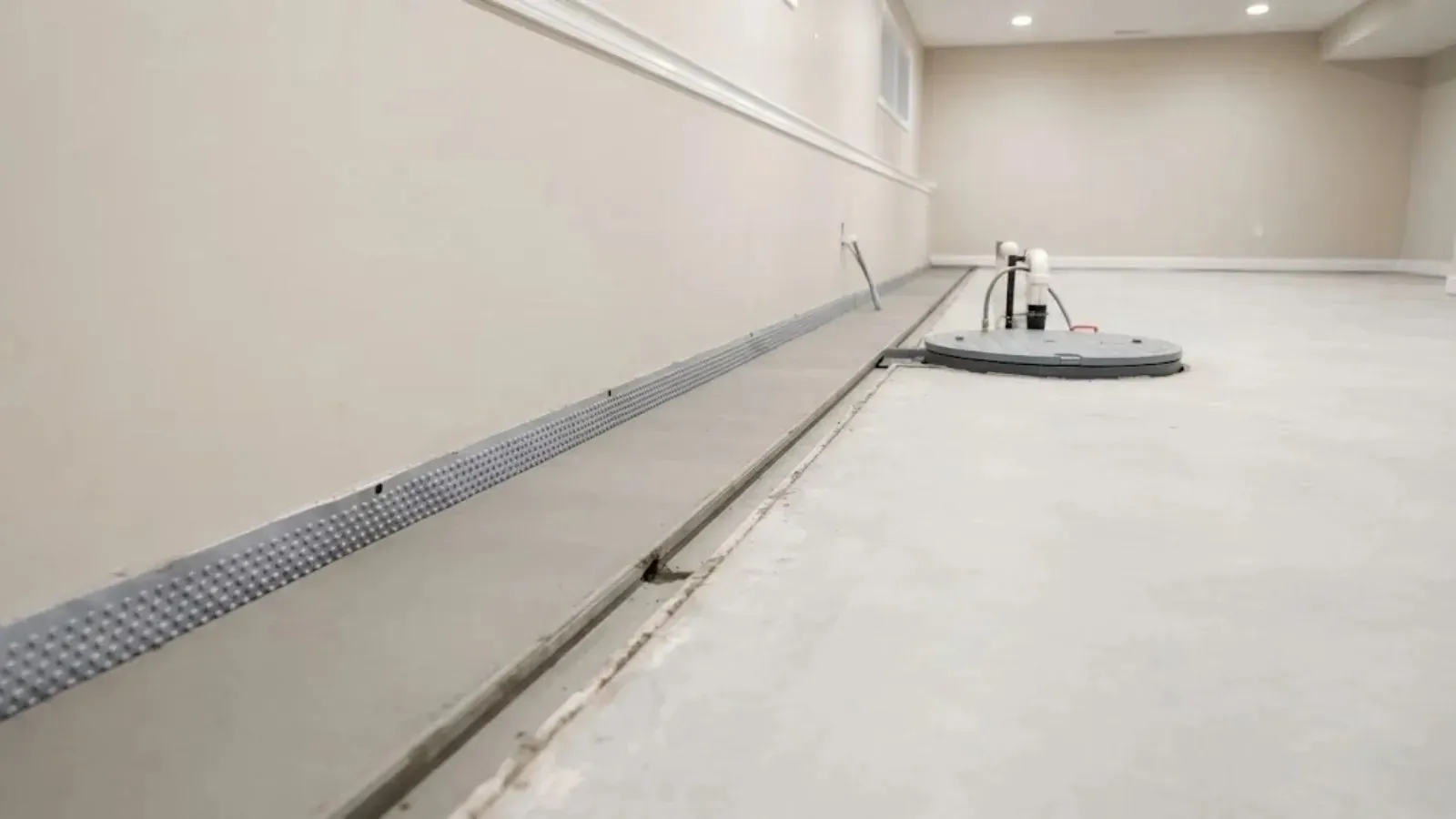
What Is Basement Waterproofing? A Guide for Brownsburg Homeowners
Basement waterproofing is a set of methods that keep groundwater and rain from entering the lower level of a house. It works by controlling where water goes, through grading and gutters outside, drains and a sump pump inside, and sealing where water gets in. The right method depends on how the water is entering.
This guide explains the main approaches, how to diagnose a wet basement and what to ask before you hire.
The basic idea: give water a path
Water pushes against a foundation after heavy rain or when the water table rises. Concrete is porous and has joints, so water finds its way through cracks, the joint where the wall meets the floor and the floor itself. Waterproofing does not stop the pressure. It gives the water somewhere to go before it reaches your floor.
That is why a coating on the wall alone often fails. If water has no exit, it builds up behind the coating and breaks through. A drain and a pump solve the pressure problem, and sealing handles minor seepage.
The main methods and what they do
Many jobs combine more than one.
| Method | What it does | Good for |
|---|---|---|
| Grading and downspout extensions | Moves rain away from the foundation | Water after rain near a wall |
| Exterior waterproofing | Coats and drains the outside of the wall | Wall seepage, when digging is possible |
| Interior drain tile | Collects water at the floor edge | Floor joint leaks and rising water |
| Sump pump | Pumps collected water outside | All interior drain systems. See sump pump service |
| Crack injection | Seals individual cracks | Isolated wall cracks |
Start with the free fixes
Many damp basements improve before any construction.
- ✓Clean gutters and extend downspouts several feet from the foundation.
- ✓Regrade soil so it slopes away from the house.
- ✓Keep window wells clear and covered.
- ✓Fix any plumbing leak before blaming groundwater.
- ✓Keep a dehumidifier running to control humidity, not as a fix for leaks.
Wet basement after storms?
Call and we will help work out where the water comes from.
How to diagnose where the water comes from
Look at the pattern. Water that shows up only after heavy rain points to runoff and gutters. Seepage along a wall crack points to the wall. Water at the edge of the floor points to the floor joint. Water that appears in dry weather points to a plumbing leak or high groundwater.
A simple test tapes a square of plastic to a wall. If moisture forms on the room side, it is condensation. If it forms behind the plastic, it is seepage. A plumber can also run a meter test to rule out a supply leak. See leak detection for how that works.
Exterior or interior waterproofing
Each has a place.
Exterior work
- Stops water at the wall
- Needs excavation
- Costs more and disturbs the yard
- Best for new construction or major wall repair
Interior drainage
- Manages water that gets in
- Installed from inside
- Works with a sump pump
- Common for existing homes
Clay soils and spring storms in central Indiana
Central Indiana soils include clay, which drains slowly and holds water against foundations. Hendricks County gets heavy spring storms, and the Town of Brownsburg's growth has put thousands of homes with basements on the land around it.
If your basement is damp only in spring, outside water control is the first fix. If it is wet even in dry weather, groundwater or a plumbing leak is more likely. The Town building department at (317) 852-1120 can say how permits apply to drain and pump work.
The EPA advises drying water-damaged materials within 24 to 48 hours to limit mold, and the Indiana Plumbing Code applies to the drain and pump work.
Questions to ask a contractor
Ask how the contractor decided on the method, and what evidence they found. A good answer refers to where the water enters, not to a standard package. Ask who does the work, whether the system includes a backup pump and a clean-out, and what the warranty covers and whether it transfers when you sell.
Get the scope in writing, with the length of wall treated and the finish of the floor patch. Compare more than one quote, and be wary of urgency tactics. Water problems rarely get worse overnight, so you have time to compare.
What affects the price of waterproofing
The scope follows the diagnosis.
Policies often exclude groundwater and seepage. Ask about a water backup endorsement before the wet season. We serve Avon and the wider Brownsburg area from the same 24/7 line.
What waterproofing will not fix
It will not repair a structural crack that is widening, a wall that bows inward or a foundation that has settled. Those are engineering problems, and an engineer should look at them before any drain is installed.
It also will not fix humidity from a dryer vent that exhausts into the basement or from wet laundry hung to dry. A dehumidifier and a sealed vent are the simple answers for those.
Basement waterproofing questions
For minor dampness it can help, but paint does not stop water pressure. If water pushes through, a drain system is needed.
A well-installed interior system can last decades, and the pump needs replacement every several years.
Not necessarily. Horizontal cracks, bowing walls and stair-step cracks do signal structural issues, and an engineer should look at those.
It stops the moisture. Mold already present needs separate cleaning.
Many do, especially in newer neighborhoods with basements. Test yours twice a year.